
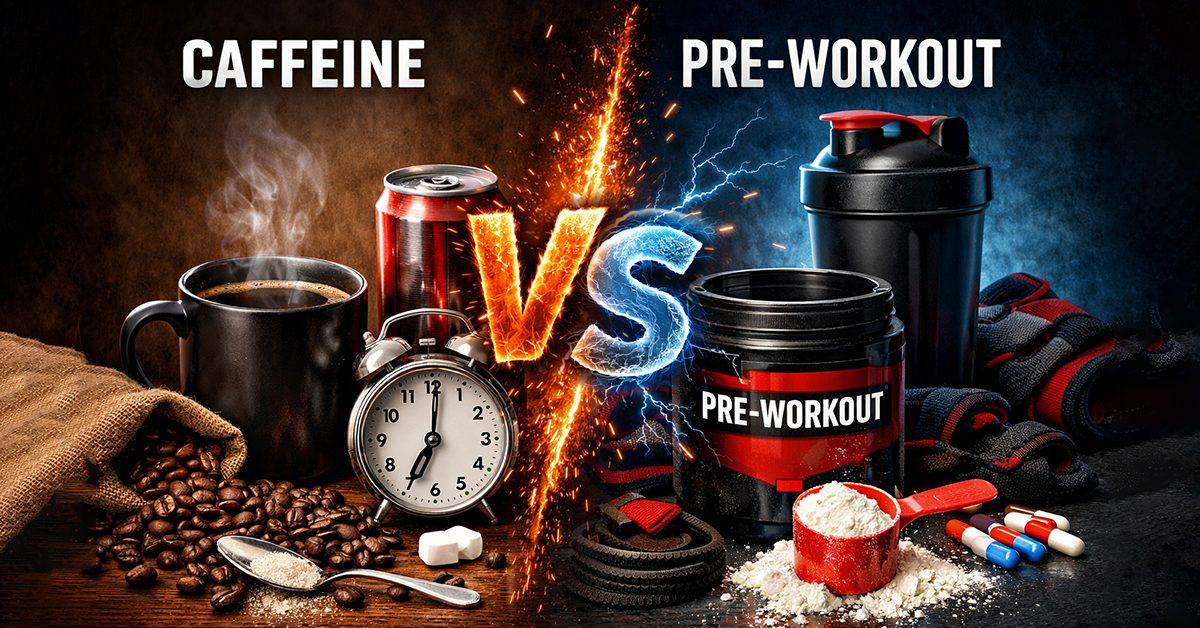
Supremacy of Coffee vs Pre-workout supplement to boost workout performance has been a long debated subject. The fitness community invariably finds itself divided regarding this matter. Though advocates on both sides claim the superiority of their preferred option, scientific studies reveal the real picture.
Enter any gym and you will find people sipping brightly coloured preworkout drinks. Others come with their morning coffee in their hands. The two groups boast their decision to be the best one to meet the crushing workouts. Which one of them works better? We shall analyze the science, advantages and disadvantages of each proposal.
What’s Actually in Your Pre-Workout?
Pre workouts are complicated formulas. They are usually a blend of ingredients that boost performance and usually include caffeine, beta-alanine, creatine and nitric-oxide-enhancing substances like citrulline. The majority of them contain caffeine as one of the main ingredients and the average dose is approximately 150-300 mg per serving, which is usually more than a normal cup of coffee.
Typical supplements are beta-alanine, which acts to buffer the hydrogen ions and may delay fatigue during high-intensity exercise, but often produces an unpleasant, but harmless, tingling sensation (paresthesia). Citrulline malate has the potential to stimulate the production of nitric oxide and blood flow to aid the so-called muscle pump and even decrease soreness. Addition of creatine monohydrate is often due to its effects of augmenting intramuscular phosphocreatine reserves, which facilitate short-duration work of high intensity.
Most of them contain taurine, tyrosine, and other amino acids, and some contain nootropics to focus the mind but all the added components are not as well supported by evidence. The amount of caffeine in these products is highly varied: some of them have approximately 150 mg of caffeine per serving, whereas some of them have 300-400 mg or more. A pre-workout is, in practice, a multi-ingredient cocktail that is intended to be used to mix several ergogenic aids into a single scoop.
How Effective is Coffee As Pre-Workout?
Coffee is straightforward. It is a natural beverage that delivers caffeine along with other bioactive compounds.
Your morning coffee contains caffeine naturally, as do other drinks like tea and energy drinks, but coffee is the most common pre‑gym choice.
A typical cup of brewed coffee provides about 95 mg of caffeine, while an espresso shot delivers about 63 mg. Coffee shop drinks can range widely depending on size and preparation.
The caffeine in coffee works by blocking adenosine receptors, preventing the drowsiness signal from reaching your brain. The result? Increased alertness and energy.
Research consistently shows that caffeine from sources like coffee can improve exercise performance, with studies demonstrating enhanced endurance, strength, and power output.
Coffee vs Preworkout: Head-to-Head Comparison
Both options can significantly boost your workout. But they work differently.
Coffee (via its caffeine content) improves endurance by a few percent in many studies. It reduces perceived exertion, meaning hard work feels easier. Your focus sharpens. Reaction time quickens.
For strength training, caffeine from coffee can increase power output. You might squeeze out an extra rep or two. The mental edge helps you push through challenging sets.
Pre-workouts offer these same caffeine benefits. But the additional ingredients provide extra advantages.
Beta-alanine buffers lactic acid buildup. This delays muscle fatigue during high-intensity exercise. Citrulline malate enhances blood flow to working muscles. Better blood flow means more oxygen and nutrients.
Creatine increases ATP production, your muscles’ immediate energy source. The result is improved strength and power.
The combination creates a synergistic effect. Multiple ingredients working together often outperform single ingredients.
Research supports this in some contexts. Studies show that complete pre-workout formulas can improve performance beyond caffeine alone, though the difference is usually modest.
Side Effects and Tolerance
Both options come with potential drawbacks. Understanding them helps you make informed choices.
Coffee (through its caffeine content) can cause jitters in sensitive individuals. Some people experience anxiety or restlessness. Sleep disruption is common if taken too late.
Your body builds tolerance to caffeine quickly. Regular users may need increasing doses for the same effect. This can create a dependency cycle.
Pre-workouts share these caffeine-related issues. But they add others.
Beta-alanine causes harmless but annoying tingling. Some formulas include excessive stimulants. This can lead to crashes after workouts.
Artificial sweeteners upset some people’s stomachs. Proprietary blends can hide exact ingredient amounts, making it hard to identify problem ingredients.
Long-term safety data is limited for many pre-workout ingredients. Coffee and caffeine, by contrast, have decades of research behind them.
Convenience and Flexibility
Coffee offers simplicity and familiarity. You can brew it at home, grab it on the way to the gym, or use instant coffee. Adjusting your dose is as simple as changing cup size or strength.
You still get a reasonably predictable caffeine hit, especially if you’re consistent with how you prepare it.
Pre-workouts require more preparation. You need to mix powder with water. Some people dislike the taste, and the powder can be messy.
Travel can be trickier with tubs of powder. Airport security sometimes questions unlabelled supplement containers.
However, pre-workouts eliminate guesswork about dosing other ingredients like beta-alanine or citrulline. Everything is premeasured in one scoop, which many users find convenient.
Who Should Choose What?
Your ideal choice depends on several factors: goals, budget, and preferences.
Choose coffee if you want simplicity. It’s perfect for beginners exploring performance enhancement. The low cost and familiarity make it accessible.
Coffee also works well if you’re cautious with additives. You avoid potential allergens or irritants from artificial flavors, colorings, and certain extra ingredients.
Choose pre-workout if you want maximum performance support in one product. The additional ingredients can provide measurable benefits, especially for intense strength or high‑intensity training. Serious athletes often find the investment worthwhile.
Pre-workouts also suit people who enjoy the ritual. Mixing a drink can be part of mental preparation. The taste and tingling sensation create a psychological boost.
If you train intensely multiple times per day, a well‑designed pre-workout may help support repeated efforts and recovery.
Making Them Work Together
You don’t have to choose exclusively. Many people use both strategically.
Use pre-workout for your hardest training sessions. Save it for leg day or heavy lifting. This maximizes value from an expensive supplement.
Use coffee for lighter workouts. Morning cardio or accessory work usually doesn’t require a full pre-workout formula. A simple coffee often suffices.
You can also cycle your stimulant use to prevent tolerance. For example, take a lower‑caffeine week every month. Your sensitivity resets, and smaller doses become effective again.
This approach balances cost, effectiveness, and sustainability. You get benefits without breaking the bank.
Conclusion: –
Here’s the truth: both coffee and pre-workout can work.
The best choice is the one you’ll actually use consistently. Consistency trumps marginal performance differences.
If coffee keeps you training regularly, it’s better—for you. If pre-workout motivates you to push harder and show up for your hardest sessions, then it wins for your situation.
Consider starting with coffee. It’s cheaper, simpler, and familiar. You’ll learn how your body responds to caffeine and timing.
If you plateau or want more targeted performance support, try a reputable pre-workout. You’ll have a baseline for comparison and can judge whether the extra ingredients provide noticeable benefits.
In the end, the real key is consistency. Choose the option you’ll actually use regularly. Smart supplementation—whether from coffee or pre-workout—combined with proper training, nutrition, and sleep delivers the best results. Start simple, train hard, and adjust based on your individual response.
How we reviewed this article:
- Grgic J et al. International society of sports nutrition position stand: caffeine and exercise performance. Journal of the International Society of Sports Nutrition. 2021.[pmc.ncbi.nlm.nih]
- Transparent Labs. Pre-workout vs. energy drinks: which boosts performance? 2025.[transparentlabs]
- Performance Lab. Coffee vs pre-workout vs energy drinks: what’s best? 2025.[performancelab]
- University Hospitals. Pre-workout supplements: are they worth taking? 2025.[uhhospitals]
- Merotto L. What is the best form of pre-workout caffeine? 2025.[leighmerotto]
- Garage Gym Reviews. Coffee vs pre-workout. 2024.[https://www.garagegymreviews.com/coffee-vs-pre-workout]
- Various controlled trials on multi-ingredient pre-workouts vs caffeine or placebo (e.g., PubMed IDs 35599920, 35565718, 7600984, 7039476).pmc.ncbi.nlm.nih+4